

Introduction
The Mikoyan-Gurevich MiG-21 (NATO reporting name: Fishbed) is one of the most famous fighter aircraft ever built. Designed by the Mikoyan-Gurevich Design Bureau in the Soviet Union, it was developed during the Cold War as a lightweight, high-speed interceptor capable of defending Soviet airspace against enemy bombers and fighters. The MiG-21 made its first flight in 1955 and entered service with the Soviet Air Force in 1959.
Over the following decades, the MiG-21 became the most-produced supersonic jet fighter in history, with more than 11,000 aircraft built. It served with over 60 countries across Europe, Asia, Africa, and the Middle East. Thanks to its simple design, low operating cost, and excellent performance, the aircraft remained in active service for more than six decades. Many air forces modernized the MiG-21 with new avionics, radar, and weapons, allowing it to remain effective long after newer fighters had entered service.
Development
During the early 1950s, military aviation advanced rapidly with the introduction of jet-powered aircraft capable of flying faster than the speed of sound. The Soviet Union sought a lightweight fighter that could quickly intercept enemy aircraft while remaining inexpensive to manufacture and maintain.
The Mikoyan-Gurevich Design Bureau began work on a new fighter using lessons learned from the MiG-17 and MiG-19. Several experimental aircraft were built before engineers finalized the design. Early prototypes experienced engine and aerodynamic problems, but continuous testing led to improvements in wing design and powerplant performance. The successful prototype first flew on 16 June 1955, and after extensive evaluation the aircraft entered operational service in 1959.
The MiG-21 featured a distinctive delta wing, which provided excellent high-speed performance and allowed the aircraft to reach speeds exceeding Mach 2. Although the delta-wing configuration reduced low-speed maneuverability, it offered outstanding stability at high altitude and simplified the aircraft's construction.
The fighter was exported widely to Soviet allies and friendly nations. It was also produced under license in countries such as India, Czechoslovakia, and China, where the aircraft evolved into the Chengdu J-7/F-7 family.
Design and Features
The MiG-21 was designed with simplicity and reliability in mind. It used lightweight construction and a compact airframe, making it easier to maintain than many contemporary fighters. The aircraft was powered by a single Tumansky R-25-300 turbojet engine with afterburner, enabling a maximum speed of approximately 2,230 km/h (Mach 2.05).
One of the MiG-21's most recognizable features is its sharply swept delta wing. This design reduced drag at supersonic speeds while providing excellent climb performance. The aircraft could reach a service ceiling of nearly 19,000 meters, allowing it to intercept high-flying reconnaissance aircraft and bombers.
The cockpit was designed for a single pilot and contained relatively simple flight instruments compared with later fourth-generation fighters. While early variants relied mainly on ground-controlled interception, later versions received improved radar, navigation equipment, and electronic countermeasures.
The MiG-21 could operate from relatively short runways and required minimal ground support. Its rugged landing gear and simple maintenance procedures made it especially suitable for countries with limited military infrastructure.

Specifications
The MiG-21bis, one of the most advanced production versions, has the following specifications:
- Crew: 1
- Length: 14.7 m
- Wingspan: 7.15 m
- Height: 4.1 m
- Empty weight: Approximately 5,300 kg
- Maximum takeoff weight: Up to 10,400 kg
- Engine: 1 × Tumansky R-25-300 afterburning turbojet
Performance
- Maximum speed: 2,230 km/h (Mach 2.05)
- Cruising speed: Around 1,000 km/h
- Combat radius: Approximately 370 km
- Ferry range: Up to 1,470 km with external fuel tanks
- Service ceiling: About 19,000 m
Armament
The MiG-21 carried a powerful combination of guns, missiles, rockets, and bombs suitable for both air-to-air and air-to-ground missions.
Typical weapons included:
- One 23 mm GSh-23L twin-barrel cannon
- R-3 (K-13), R-13M, R-60, and R-60M air-to-air missiles
- Kh-66 air-to-surface missiles on compatible variants
- Unguided rocket pods
- General-purpose, fragmentation, and cluster bombs weighing up to 1,000 kg
These weapons allowed the aircraft to perform interception, close air support, ground attack, and limited strike missions.
Combat History
The MiG-21 earned its reputation in numerous conflicts around the world. It first gained international attention during the Vietnam War, where North Vietnamese pilots used it against American aircraft such as the F-4 Phantom II and F-105 Thunderchief. Although both sides reported different victory claims, the MiG-21 proved to be a dangerous opponent when employed with effective tactics and ground-controlled interception.
The aircraft also participated extensively in the Arab-Israeli Wars, serving with the air forces of Egypt, Syria, and Iraq. During these conflicts, MiG-21s engaged Israeli Mirage and Phantom fighters in some of the largest jet air battles of the Cold War.
In South Asia, the MiG-21 became one of the most important fighters operated by the Indian Air Force. Indian MiG-21s saw combat during the 1971 Indo-Pakistani War, where they performed both air-defense and ground-attack missions. The aircraft remained in Indian service for decades and received several modernization programs, including the MiG-21 Bison upgrade.
The MiG-21 also served in the Iran-Iraq War, the Balkan conflicts, numerous African wars, and several Middle Eastern conflicts. Its widespread use demonstrated its adaptability under different combat conditions and climates.
Although newer aircraft eventually surpassed the MiG-21 in radar, avionics, and missile technology, experienced pilots continued to achieve success with upgraded versions of the aircraft.
Variants and Upgrades
More than 20 major variants of the MiG-21 were produced during its long service life. Early versions focused primarily on daytime interception, while later models introduced better radar, stronger engines, increased fuel capacity, and improved weapons capability.
Some of the most notable variants include:
- MiG-21F-13 – Early production fighter with improved weapons.
- MiG-21PF – Equipped with radar for all-weather interception.
- MiG-21PFM – Improved avionics and weapons systems.
- MiG-21M and MiG-21MF – Export versions with upgraded radar and engine.
- MiG-21bis – The most advanced Soviet production model, featuring the powerful R-25 engine and improved performance.
- MiG-21 Bison – Indian modernization program with a modern pulse-Doppler radar, upgraded cockpit displays, electronic warfare systems, and compatibility with advanced air-to-air missiles.
- Chengdu J-7/F-7 – Chinese-built version of the MiG-21, produced in large numbers and exported worldwide.
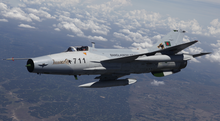
These upgrades significantly extended the aircraft's operational life and allowed many countries to continue using the MiG-21 well into the twenty-first century.
Legacy
The MiG-21 remains one of the most influential fighter aircraft ever developed. Its combination of speed, simplicity, affordability, and reliability made it a symbol of Soviet aviation during the Cold War. More than 11,000 aircraft were produced, making it the most-built supersonic jet fighter in history.
Many nations gradually replaced the MiG-21 with more advanced fourth-generation fighters such as the MiG-29, Su-27, F-16, and JAS 39 Gripen. Nevertheless, upgraded MiG-21s continued to serve in several air forces well into the 2020s, demonstrating the durability of the original design.
The aircraft also played a significant role in pilot training and military aviation development across dozens of countries. Museums and air shows around the world continue to preserve the MiG-21 as an important milestone in aviation history.
Conclusion
The Mikoyan-Gurevich MiG-21 is one of the most successful fighter aircraft ever built. Designed as a lightweight supersonic interceptor, it combined high speed, excellent climb performance, and low operating costs in a simple yet effective design. Its ability to perform air-defense, interception, and ground-attack missions made it a versatile combat aircraft for more than six decades.
Despite being developed during the 1950s, the MiG-21 remained relevant through continuous modernization and upgrades. Its remarkable production numbers, extensive combat experience, and long service life have secured its place as one of the greatest military aircraft in aviation history.
gjb
Post a Comment